Human-Centered AI · ARTICLE
The Hidden Work Behind Useful AI
Why adoption, trust, and business value depend on what happens after AI gives an answer
Imagine using AI to prepare a customer proposal. The first draft appears in seconds. Then you check its claims, correct the pricing, explain the customer’s needs again, and rewrite the conclusion.
The AI produced something quickly. But did it make the whole task easier?
That question connects seven recent sources on AI adoption, user experience, and business value. Together, they suggest a useful direction for human-centered AI: evaluate the full journey from a person’s need to a dependable result. The answer on the screen is only one part of that journey.
A good answer can still take too much work
Research by Imai and colleagues examined two datasets covering four tasks. Sessions with the same quality rating differed by up to 70 times in interaction cost—the effort involved in working with the AI. This was a maximum observed difference, not a typical saving that every product should expect. Read the research [1].
The finding helps explain why an impressive demonstration may feel less useful in daily work. Two people can reach equally good results, while one spends much longer correcting misunderstandings.
For product teams, this means measuring more than output quality:
- How often must people repeat or clarify instructions?
- How much time do they spend checking and repairing answers?
- Can they use the result in their actual workflow?
A product becomes more useful when it delivers a dependable outcome with manageable effort.
Checking is part of the user journey
The work often continues after an answer looks finished.
A Fast Company article reports that 86% of 623 surveyed AI-assisted shoppers checked recommendations through another source before buying. The figures come from an industry-sponsored survey and describe self-reported behavior. They do not establish how much extra time AI caused shoppers to spend. Read the analysis [2]. Read the primary survey.
Still, the design implication is practical: verification belongs inside the experience we study.
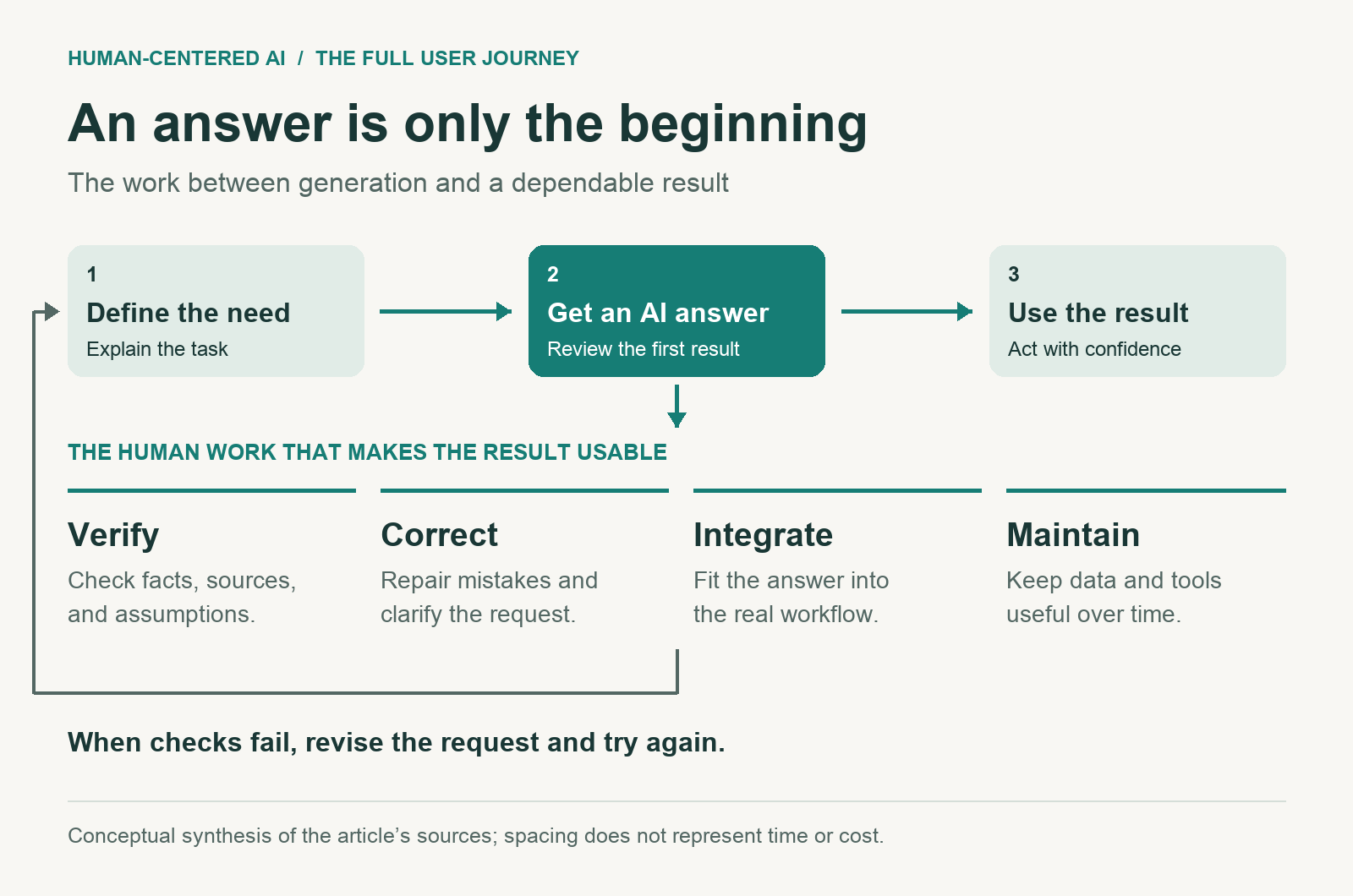
Read the diagram as text
- Define the need: Explain the task.
- Get an AI answer: Review the first result.
- Verify: Check facts, sources, and assumptions.
- Correct: Repair mistakes and clarify the request.
- Integrate: Fit the answer into the real workflow.
- Maintain: Keep data and tools useful over time.
- Use the result: Act on a dependable result.
These activities can repeat. When checks fail, revise the request and try again.
Accessible sources, clear comparisons, and visible assumptions can help people check an answer. These features should be tested to see whether they actually reduce effort and improve decisions.
Consider an AI shopping assistant. A recommendation becomes easier to evaluate when the product shows the current price, explains which requirements it meets, and links to supporting information. The useful outcome is a decision the person can justify.
Trust should help people make better decisions
“Do you trust this AI?” is a useful question, but it cannot tell us everything.
A systematic review of 33 publications found varied definitions and methods for studying trust in AI. That variation makes simple conclusions about “what increases trust” difficult. Read the review [3].
A stronger product test is whether people can recognize when to use an answer, check it, or reject it. This is often called appropriate reliance.
For example, a user might reasonably accept help rephrasing a sentence while checking a recommendation that depends on current prices. The goal is to help people judge the answer in context.
Research can test this directly: give participants a mixture of correct, uncertain, and incorrect answers, then observe whether they make suitable decisions. A high trust rating alone would miss that distinction.
Deployment can outpace readiness
The surrounding organization matters too.
According to Express Computer’s coverage of the Modern Data Report, a survey of more than 540 data professionals across over 65 countries found a large difference between reported agent activity and confidence in production data. 57.3% reported piloting or running AI agents, while 8.4% considered their data trustworthy enough for production. Read the report coverage [4]. Read the survey publisher’s findings.
Activity is not the same as readiness
Share of respondents · the same 0–100% scale
Piloting or running AI agents57.3%
Data considered trustworthy enough for production8.4%
Modern Data Survey · 540+ responses · 66 countries · interim findings, August 2026.
For teams building AI agents—systems that can take actions in a workflow—this raises basic questions:
- Is the information current and accurate?
- Who owns the data and resolves conflicting definitions?
- What information may the agent access?
- Who handles a mistake or an uncertain case?
Those decisions shape the user experience as directly as the interface does. A clear screen cannot compensate for an agent acting on outdated information.
Adoption depends on people’s circumstances
An NBER working paper describes generative AI adoption as widespread but shallow. Its nationally representative US survey found use across many occupations and tasks, yet fewer than half of workers adopted it within most of them. Estimates of which tasks AI could assist explained only part of actual adoption. Read the working paper [5].
The research implication is to compare people doing similar work. Why does one person keep using AI while another stops?
Possible explanations to investigate include workflow fit, skills, organizational permission, and the effort required to check results. These are research questions, not causes established by the paper.
For a product team, interviewing people who stopped using the tool may reveal as much as studying enthusiastic users. Their experience can expose costs that usage totals hide.
Useful AI needs ongoing support
MIT Sloan’s account of a two-year study of two organizations highlights the continuing work involved in testing, reviewing, integrating, and maintaining AI tools. Sustained participation was associated with support such as shared evaluation methods, technical help, and recognition for employees’ contributions. The comparison does not isolate the causal effect of each practice. Read the MIT Sloan analysis [6].
This suggests an important planning question: Who will keep the tool useful after launch, and how will that work fit into their responsibilities?
BCG’s survey of more than 1,300 senior leaders adds a business perspective: connect AI initiatives to clear priorities and track outcomes. Its reported relationships are associations rather than proof that particular practices caused greater value. Read the BCG analysis [7].
A practical starting point is one clearly defined workflow. Measure the result, the total effort required, and the costs of operating it.
What teams should measure
Together, these sources suggest a practical scorecard:
| What to measure | A plain-language question |
|---|---|
| Sustained adoption | Do people keep using it for this task? |
| Outcome quality | Is the result correct and useful? |
| Human effort | How much checking and correction does it require? |
| Operational readiness | Are the data, permissions, and responsibilities clear? |
| Appropriate reliance | Can people recognize when to check or reject an answer? |
| Business value | Does the complete workflow improve after costs are included? |
The most revealing question may be simple: Once people have checked, corrected, and used the result, is their work better?
That is where human-centered AI becomes measurable.
Sources and evidence notes
Sources checked on 9 October 2026. The practical recommendations and scorecard are an editorial synthesis, not a validated framework.
- From Task Success to Productive Success: Evaluating Human-AI Collaboration by Quality and Cost
Two datasets and four tasks. The 70× difference is a maximum observation, not an expected saving.
- The 2026 Trust in AI Commerce Report
1,463 US online shoppers; the 86% uses the subgroup of 623 AI users. Self-reported behavior, not a causal measure of time spent.
Fast Company commentary, 2 October 2026 - Trust and interaction design in AI-enabled systems: a systematic literature review
33 included publications; definitions and methods vary. The article’s suggested product tests are practical interpretation.
- 5 Emerging Trends in Enterprise Data & AI
540+ responses from data leaders and practitioners across 66 countries. Separate self-reported measures; not a representative estimate of all organizations.
Express Computer coverage, 6 October 2026 - What Work Does Generative AI Do?
Nationally representative US worker survey. Working paper, not a peer-reviewed journal article. Proposed explanations for adoption differences remain questions to investigate.
- Why some organizations turn AI experiments into business value while others quietly fail
Two-year field study of two organizations. It does not isolate the causal effect of individual support practices.
- The Formula for Agentic AI Value — The Applied AI Index 2026
Survey associations and reported business outcomes; not proof that a practice caused greater value.