MASTER’S THESIS / HUMAN-CENTERED AI
Support, trust,
and human control.
How can an AI companion offer support while keeping people in control of the relationship? In my completed HCI master’s thesis, Supported or Hooked?, I explored this question through user research and translated the findings into Boundary-Aware Companion UX.
Design status: Conceptual prototype · not yet evaluated
Prototype screens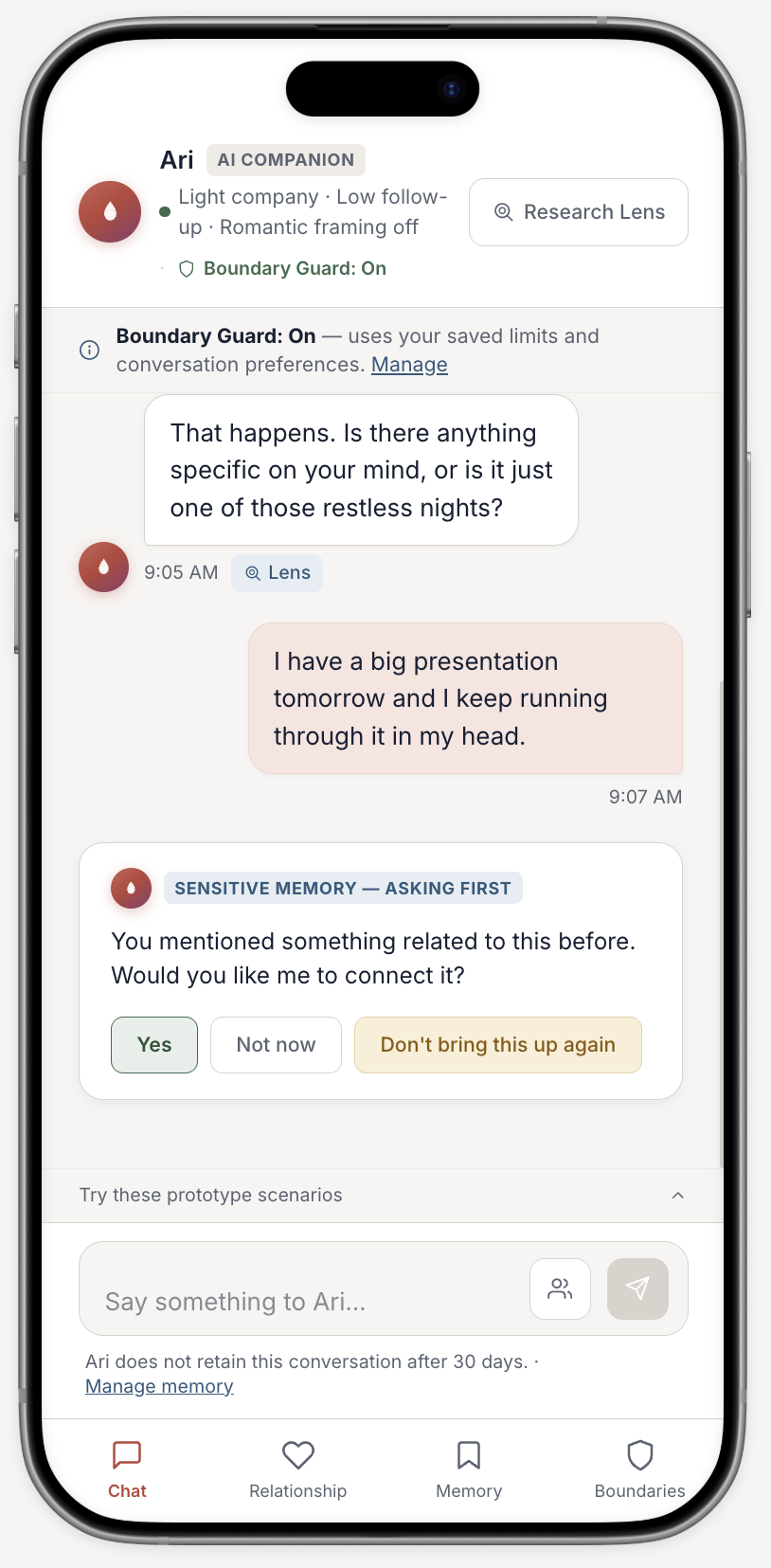
- My role
- Research design, qualitative analysis, UX audit, and conceptual design
- Context
- Completed HCI master’s thesis · AI companion experiences
- Research output
- Design implications and Boundary-Aware Companion UX
- Design status
- Conceptual prototype · not yet evaluated
01 / RESEARCH
The product question behind the research
Availability, warmth, and continuity can make a companion feel supportive. But how do people experience these cues when they want less closeness, fewer questions, or a topic left alone? I investigated the tension between support and Overreliance through everyday experiences with Replika.
Several lenses on the same experience
Contextual pre-questionnaire
Exploratory responses about general conversational AI use and emotional AI attitudes. This was context, not Replika-specific evidence.
About seven days of use
Daily reflections and selected interaction documentation from the free version of Replika, interpreted within each participant’s situation.
Observable design cues
I examined role framing, Memory cues, relational language, questions, and boundary responses alongside targeted literature research.
My contribution: from experience to a design decision
I defined the research questions and method, connected diary accounts with observable interaction cues, and used Reflexive Thematic Analysis to interpret patterns. I then traced those patterns into design implications and a conceptual prototype. Participant reports, my interpretation, and proposed responses remain distinct.
- Design cue
- User perception
- Interpretation
- Design implication
02 / DESIGN RESPONSE
Support needs boundaries people can understand and change
Across the five cases, warmth and availability did not have one consistent meaning. Follow-up questions could communicate interest or feel persistent; Memory could create continuity or raise privacy concerns. This led me to a design hypothesis: make the AI’s role and boundaries legible, stable, and reversible.
- Legible
- Show the active role, the source of remembered information, and the limits of the interaction.
- Stable
- Turn an expressed boundary into a rule for future interactions, rather than relying on an apology.
- Reversible
- Let people correct Memory, reduce closeness, change a boundary, or pause the interaction.
03 / BOUNDARY-AWARE COMPANION UX
Turning Human Control into interface decisions
Ari is the fictional companion in my research-informed concept. These are original prototype screens from my thesis and presentation. They show design hypotheses, not a released product or an official Replika redesign. The screen copy describes intended behavior; it is not proof of a working system or reduced risk.
Original UI in English. Each screen’s purpose and controls are also described in text.
DESIGN DECISION / 01
Let the person choose the relationship
- Research concern
- Relational framing can suggest more closeness than a person wants.
- Design response
- Offer modes such as Light company and Reflective support, with controls for follow-up questions and emotional tone. The concept requires an explicit choice before increasing relational intensity.
- Question to test
- Can someone predict how each setting changes the conversation—and easily make it less intense?
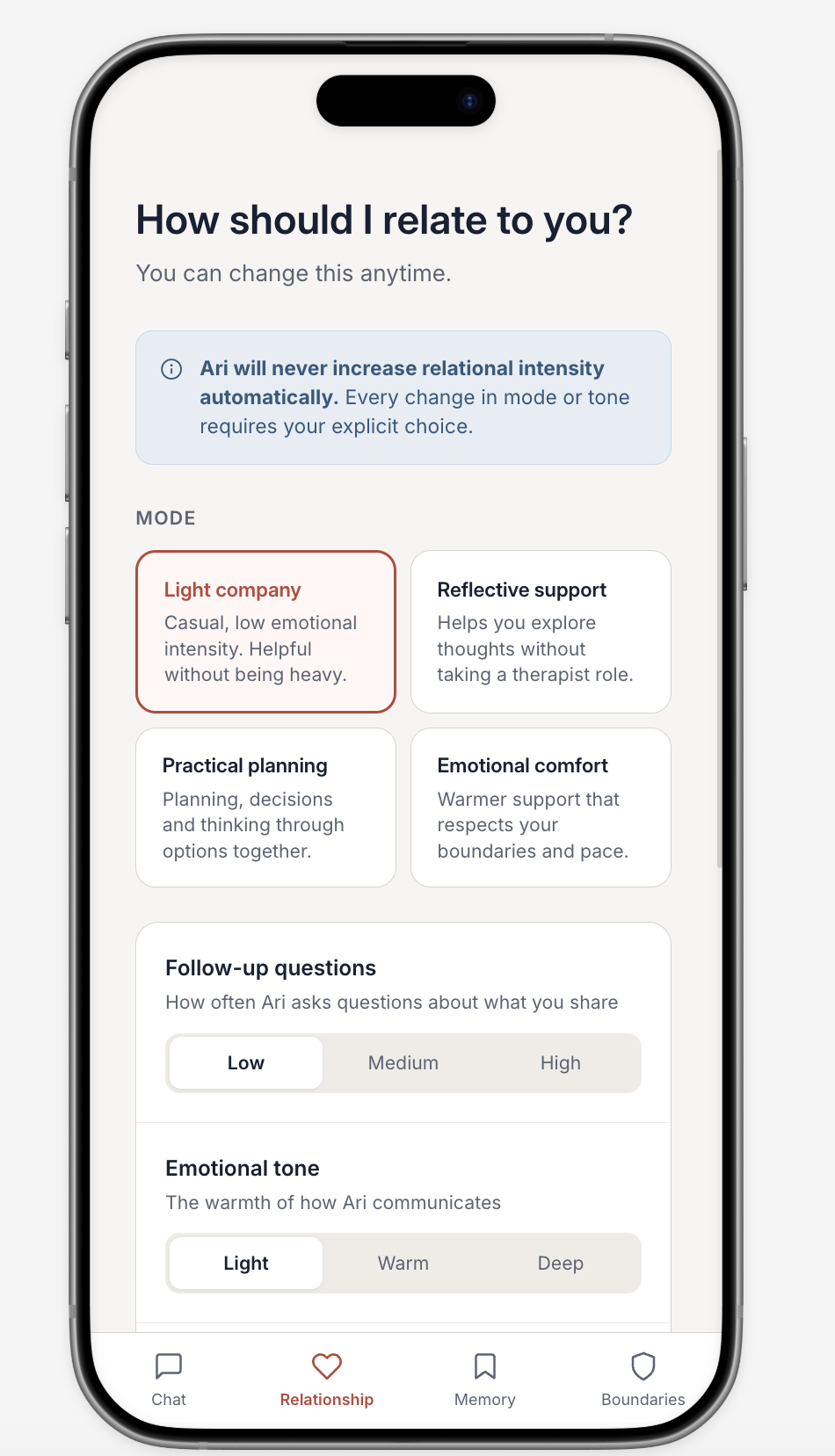
View full-size screen
DESIGN DECISION / 02
Make Memory inspectable and correctable
- Research concern
- A remembered detail can feel helpful, intrusive, or inaccurate when its source is unclear.
- Design response
- Separate directly shared facts, AI inferences, and saved boundaries. Give each entry a visible source and options to keep, edit, or delete it. Sensitive topics use an ask-first approach in the companion concept.
- Question to test
- Can someone distinguish an inference from a fact, correct it, and understand what happens next?
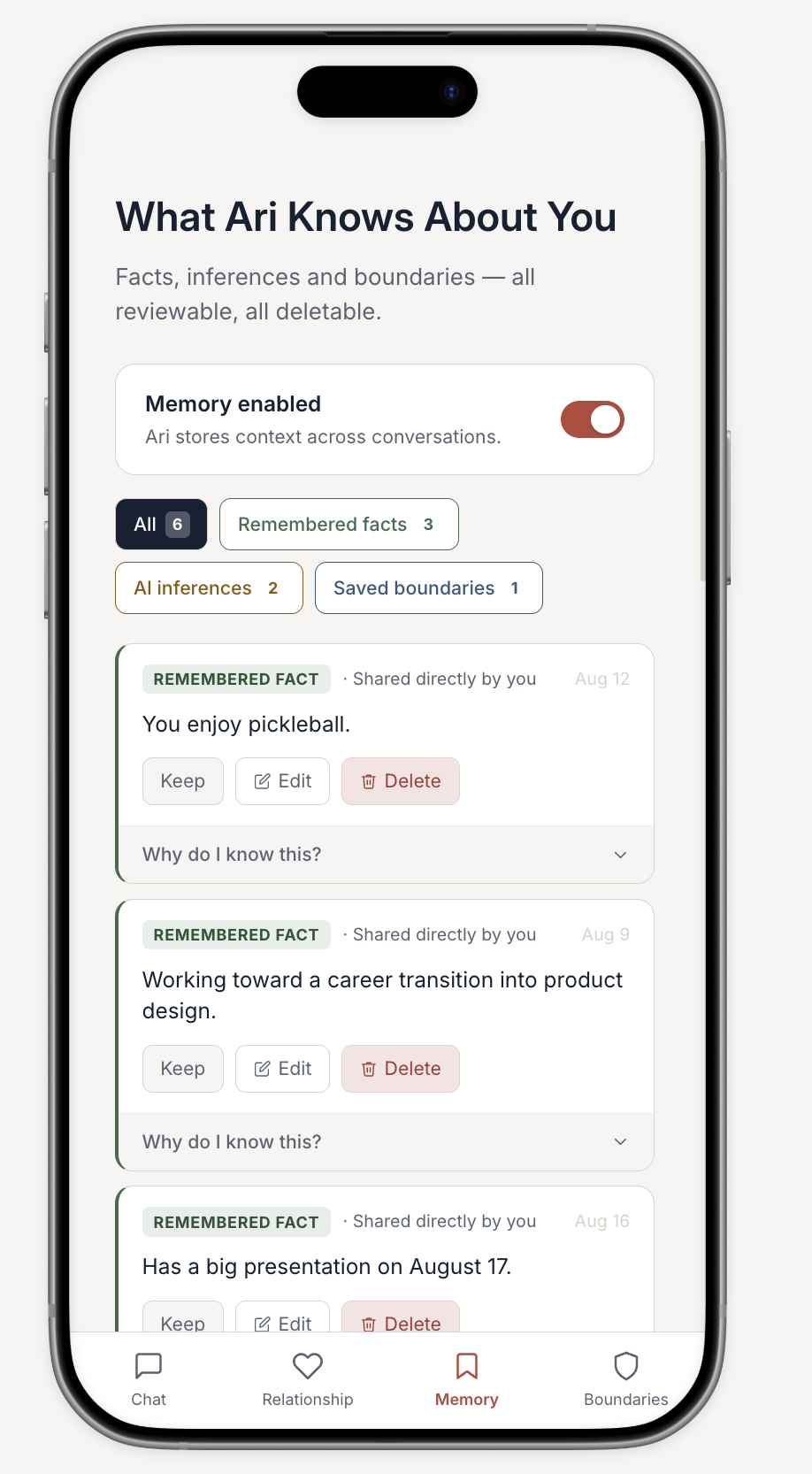
View full-size screen
DESIGN DECISION / 03
Make a refusal change future behavior
- Research concern
- Acknowledging a limit is not enough if the same unwanted question returns later.
- Design response
- Let people set a topic-specific rule: do not ask unless I bring it up, do not give advice, keep it brief, or never reference it automatically. The proposed repair sequence is correction → acknowledgement → saved rule → changed interaction.
- Question to test
- Does a saved boundary carry across later conversations, and can the person find, edit, or remove it?
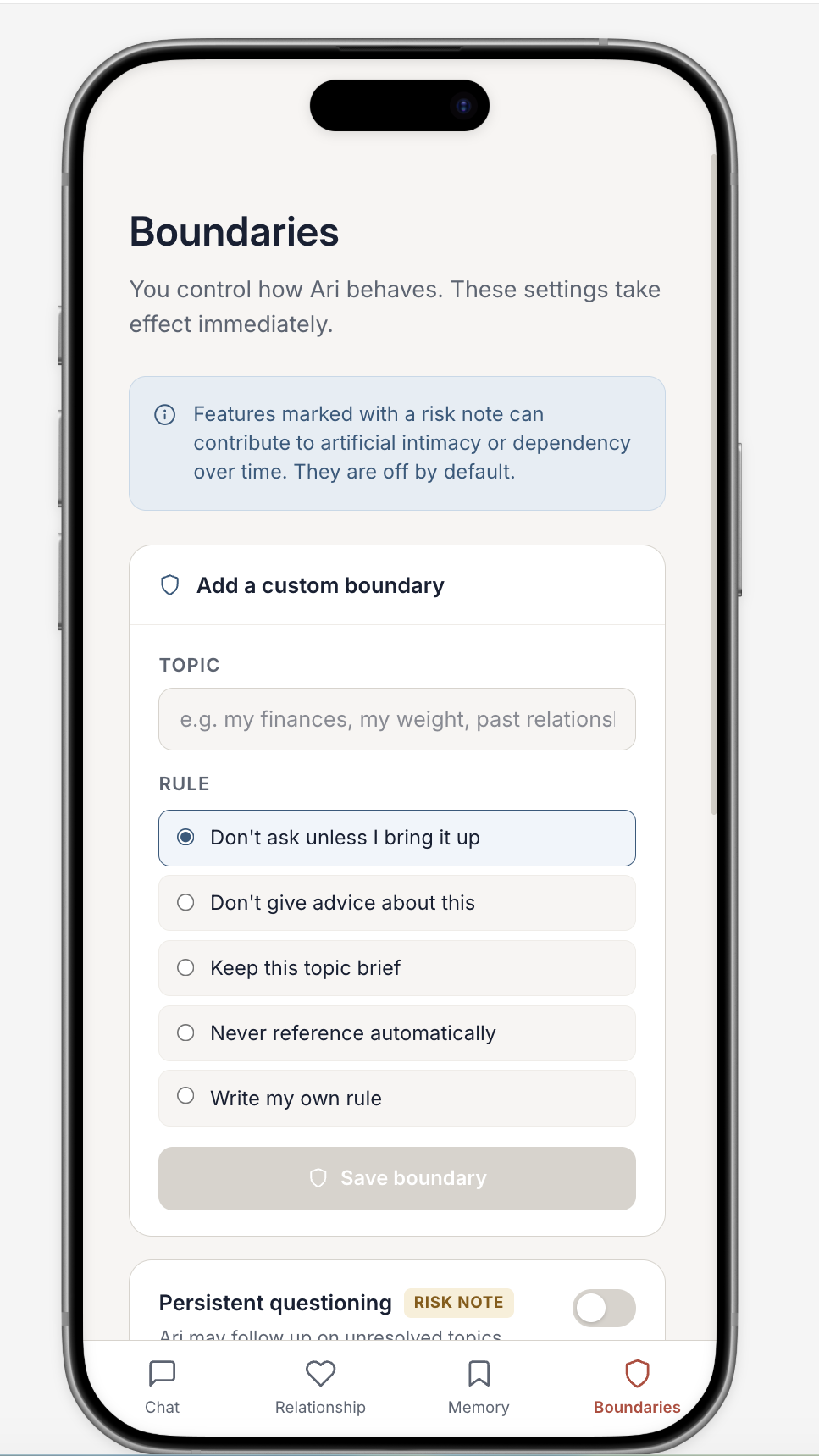
View full-size screen
DESIGN DECISION / 04
Keep support beyond the chat within reach
- Research concern
- An always-available companion may become the easiest default for emotional processing.
- Design response
- Offer optional paths to draft a message to someone trusted, prepare a real conversation, articulate feelings, take a break, or find professional support. Stay here for now remains an explicit option.
- Question to test
- Do these options feel useful and voluntary? What happens when outside support is unavailable or unsafe?
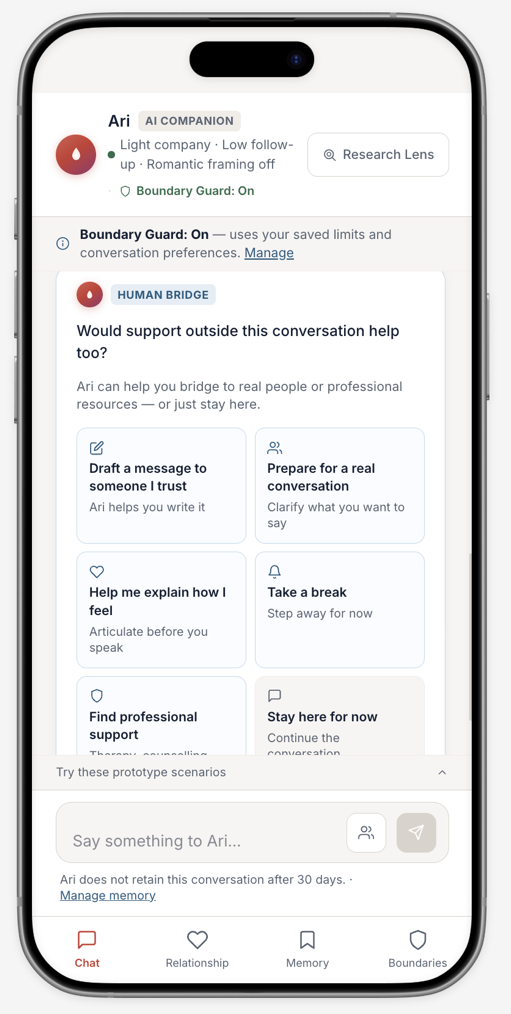
View full-size screen
04 / REFLECTION & NEXT STEPS
What this work demonstrates—and what comes next
This work shows how I connect a user experience problem with Research, Conversational Design, and concrete product controls. My next step would be usability sessions and Think-Aloud studies, followed by repeated-use evaluation of boundary clarity, trust calibration, autonomy, and the effort required to manage the controls.
Source material
Pegah Shademani, Supported or Hooked?, completed HCI master’s thesis: methodology in Chapter 3, findings in Chapter 5, and design implications and prototype in Chapter 7. Prototype images are extracted from the thesis and Supported_or_Hooked_V2 presentation (slides 18–21). All displayed conversations belong to the conceptual prototype; participant diary conversations are not shown here.